- Home
- The Creativity Group
- More than Methods: Using Stories to Humanize CPD: An Interview with Alan Maley
More than Methods: Using Stories to Humanize CPD: An Interview with Alan Maley
Editorial
You can watch and listen to the interview published in TTJ, our sister magazine, here
or here
What happens when an experienced educator and long-time advocate of storytelling turns his attention to teacher development? In this interview, Professor Alan Maley, one of the most influential figures in English Language Teaching, joins Dr. Chang Liu for an in-depth conversation about his latest book, Using Wisdom Stories in Language Teacher Education (Pavilion Publishing). Together, they explore the emotional, philosophical, and practical dimensions of using stories to support the personal and professional development of teachers.
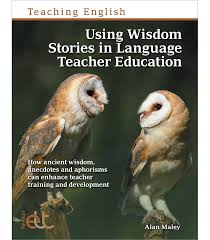
The discussion opens with the origins of the book, rooted not in a single “aha” moment, but in over 20 years of collecting, telling, and reflecting on stories. Reflecting on this long journey, Professor Maley recalls, “I have been collecting wisdom stories now for over 20 years… gradually the idea came that… these were a very nice way of getting a discussion going about all sorts of interesting and relevant ideas concerning teaching.” He goes on to share how wisdom stories, ranging from ancient Sufi tales to modern anecdotes, can serve as useful tools in teacher education. As he puts it, these stories “don’t go directly to the idea. They stimulate people to think about an idea or several ideas.”
Rather than providing direct answers or prescriptions, these stories act as catalysts for critical thinking, introspection, and meaningful dialogue. In Alan’s view, “The intention is to stimulate thinking, not to teach, but to prompt reflection that leads to growth.” He emphasizes that stories can help teachers “stay alive” professionally by encouraging them to challenge habits, examine assumptions, and reconnect with their core values. From Alan’s perspective, CPD is not just about professional development but also “personal development… staying alive mentally and in other ways as a teacher and as a person.”
A key feature of the conversation is professor Maley’s introduction of the 8Rs framework, Read, Reflect, Relate, Respond, Recommend, Reinforce, Research, Record, which offers educators a practical and memorable way to work with stories. “It is just a simple way of thinking about… not to forget certain things. Here are things that you should perhaps be doing with this story.” This framework guides teachers through engaging with a story meaningfully and applying it to their own context, practice, and development. As Professor Maley explains, “The intention is to stimulate thinking, not to teach, but to prompt reflection that leads to growth.”
The interview explores the emotional and human dimensions of teaching, particularly empathy, care, and the personal qualities that define impactful educators. “They don’t care how much you know until they know how much you care.” (Quote from Theodore Roosevelt used by Maley to emphasize human connection in teaching.) Teachers, he reflects, are remembered more for “their personal qualities… that they cared, that they listened, that they respected opinions.” Alan recounts how teachers often remember not what a teacher taught them, but how that teacher made them feel. These reflections reinforce the central idea that teacher development must go beyond content and methodology. It must touch the heart.
Alan also reflects on the unique value of ambiguity and metaphor. Many of the stories in the book are open to interpretation, often paradoxical or puzzling at first glance. This ambiguity is not a flaw, but a feature, it invites dialogue, multiple perspectives, and deeper insight. In fact, Alan emphasizes that “you can’t teach empathy directly… but you can help people develop it by offering them the opportunity to think about things and discuss things.” This highlights the book’s indirect but powerful approach to personal growth, encouraging educators to explore deeper emotional and philosophical dimensions through reflective engagement.
Alan illustrates this with the story of a young archer who shoots an arrow at a blank wall and then paints a target around it. This image invites reflection on how teachers approach lesson planning, adaptability, and goal setting. Rather than aiming for rigid outcomes, it suggests a more flexible, responsive approach to teaching. As Alan notes, “This story… is a very good one for getting people to talk,” emphasizing its power to spark meaningful dialogue and diverse interpretations among educators.
Throughout the interview, Professor Maley also highlights a variety of text types beyond wisdom stories, including:
~ Poems that evoke emotional truths. “Poems are important because they are not always just straight down the middle… they evoke emotion and thought.”
~ Quotations that provoke discussion. “They are pithy, often provocative, and open to multiple interpretations.”
~ Metaphors that reframe familiar concepts. “If you start to develop a metaphor, it makes you think in a slightly different way about what you are doing.”
~ Anecdotes from teachers. “Teachers themselves have a lot of stories to tell… and other teachers can benefit from them.”
~ Book recommendations that offer new angles on teaching and learning. “All of them have some kind of value to helping you develop.”
Taken together, these diverse genres form a resource bank, not a rigid curriculum. This book is a collection that is “supposed to be used flexibly… to ignite something in terms of reflection and discussion.” It is a flexible and inclusive toolkit for educators looking to foster deeper professional inquiry.
As the conversation draws to a close, Professor Maley reflects on how he envisions the future use of the book. He hopes it will reach teacher trainers and trainers of trainers, becoming “one of the tools in the toolbox” that can ripple through teacher development communities. It is hoped that this book can be part of the broader movement to humanize professional development. “I don’t see it as being a bestseller… but I hope that sufficient numbers of people will be able to get access to it and use it.” While modest about its commercial reach, he is passionate about its potential impact: to inspire educators to reflect, to question, and to connect with their work in more meaningful ways.
For those new to using stories in CPD, Alan’s advice is warm and practical: “Get your hands on as many different stories as you can, build your own collection… and learn how to tell them.” And above all, remember that stories are not just teaching tools. They are mirrors, windows, and bridges to deeper understanding.
This interview is a profound invitation. Whether you are a novice teacher, an experienced trainer, or simply someone curious about the deeper currents of professional life, Professor Alan Maley’s insights will challenge, inspire, and stay with you long after the conversation ends.
Please check the Pilgrims in Segovia Teacher Training courses 2026 at Pilgrims website
Know-Ask-Explore-Learn: Taking Advantage of Learner Curiosity
Chrysa Papalazarou, GreeceThe Teacher, the Poet and the Critic: Change Cannot be Postponable
Fernanda Felix Binati, ColombiaTelling Their Stories to the World – Showing Support and Expressing Admiration for the Children of Gaza
Haneen Khaled Jadallah Palestine and UK;David Heathfield, UKMore than Methods: Using Stories to Humanize CPD: An Interview with Alan Maley
Chang Liu, China and UK