Xmas Card Activities
Hanna Kryszewska is a teacher, teacher trainer, trainer of trainers. She was a senior lecturer at the University of Gdańsk, Poland. She is co-author of resource books: Learner Based Teaching, OUP, Towards Teaching, Heinemann, The Standby Book, CUP, Language Activities for Teenagers, CUP, The Company Words Keep, DELTA Publishing, and a course book series for secondary schools: ForMat, Macmillan. She is also co-author of a video-based teacher training course: Observing English Lessons, and online course for Orient Black Swan on 21st Century Skills and Teaching the whole person: Humanising language teaching. Hania is a Pilgrims trainer, OTA trainer and editor of HLT Magazine. Email: hania.kryszewska@pilgrimsteachertraining.eu
Introduction
I have always liked using Christmas cards for language activities in class. After all, the festive time of Christmas is very much about the visual. I used card-based activities instead of singing Christmas carols. Years back I collected boxes of Christmas cards I had received and would use them in various ways in class. Here are my favourite activities.
Activity 1
Cut up a card into 6 elements. In groups of 6 each student gets one piece and describes what is in it. As a group they piece together what the card shows. Only then they can show their cards to the others.
Activity 2
2 Find 4 different cards showing the same scene e.g. a Christmas tree, a nativity scene, wintry landscape, Santa etc. In groups of 4 each student gets one card on the same theme but does not show it to the others. They describe the cards and find similarities and differences. Then they exhibit their cards and see what they missed.
Activity 3
Make a collection of different style cards e.g. tatty, nostalgic, church art, silly cartoon, sophisticated, folk style, etc. (but don’t name the style). The students have to find a word or phrase to describe the style of the card. If necessary, help them. Then have them discuss what sort of person would a given card be suitable for and which card they would never buy.
... Sadly, these activities don’t work any more as these days we get or send hardly any cards, unless we download some from the Internet. But I am sure you could think of some variations...
I still have one or two of these boxes hidden in the loft.
Some history
Activity 4
There is a lot of art history in Christmas cards. Ask the students to do a web search and find answers to the following questions:
1 Who designed the first commercial Christmas card?
2 Who was Henry Cole?
3 What were the typical themes of early Christmas cards?
4 Who send the first Christmas card?
5 Why are Courrier and Yves important in the history of Christmas cards?
6 In what are the Pre-Raphaelites’ Christmas cards different from other Victorian cards?
7 How are De La Rue’s cards different?
8 What do you think makes the worst Christmas card?
Useful sites
https://en.wikipedia.org/wiki/Christmas_card
https://culturedump.substack.com/p/a-pre-raphaelite-christmas-present
https://weirdchristmas.com/2018/12/01/the-de-la-rue-companys-christmas-cards/
https://uk.pinterest.com/stressfreeprint/the-worlds-worst-christmas-cards/
Then discuss the answers with the whole group. Best if you have data projections so that you can call up the relevant images on the screen.
Silly modern Christmas cards
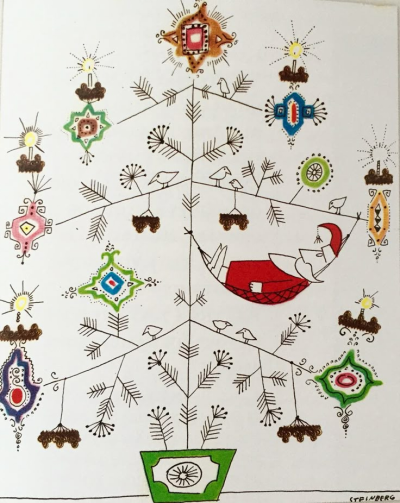
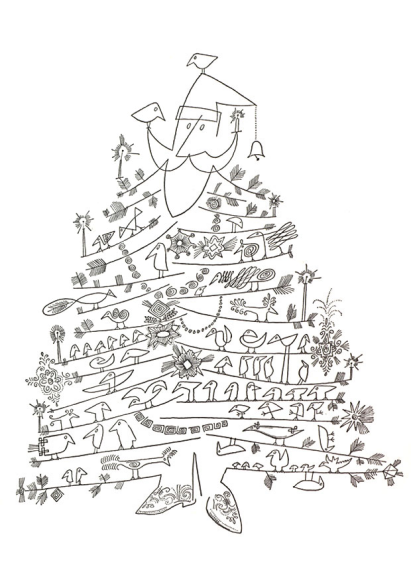
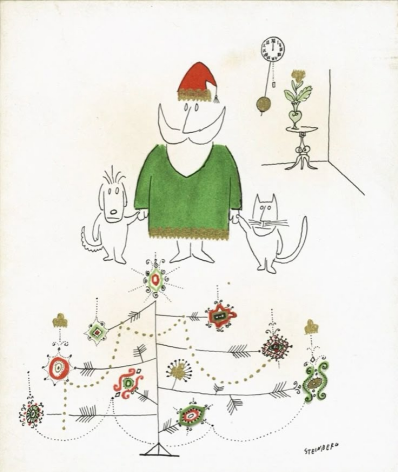
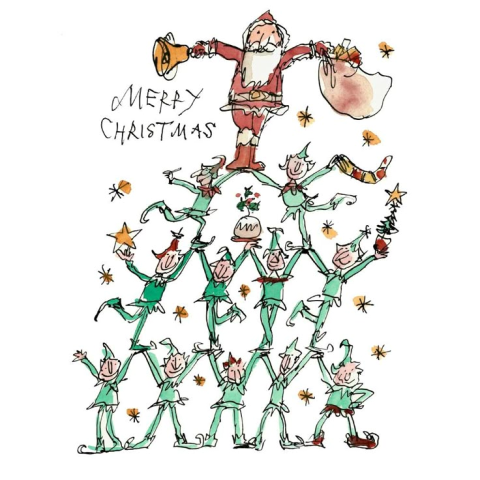
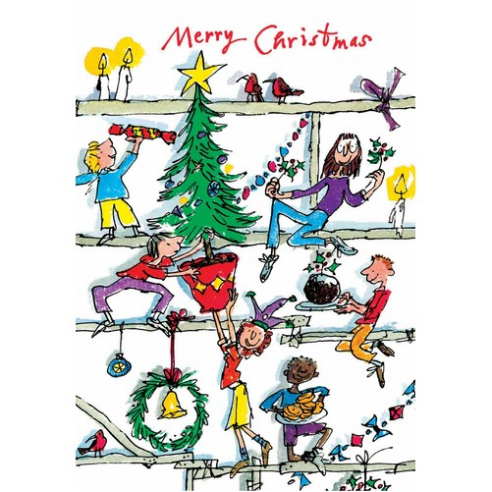
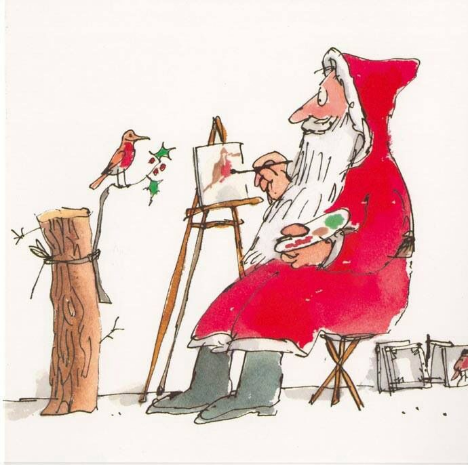
I quite like modern Christmas cards designed by artists. But I would like to focus on silly Christmas cards by Saul Steinberg and Quentin Blake. A perfect activity that works with each of these cards is as follows:
Activity 5
One student describes a card the other student cannot see, while the other tries to draw it. The drawer is allowed to ask additional questions for clarification. Then organize an exhibition of the ‘originals’ next to the student’s art.
Saul Steinberg

Quentin Blake

Biodata
Activity 6
The two sets of texts lend themselves to jigsaw reading.
1
From 1945 to 1951, Saul Steinberg created a series of whimsical black-and-white holiday cards for New York’s Museum of Modern Art. Soon after, in 1952, greeting card giant Hallmark produced a series by famous artists and writers as part of their “Hall of Fame Collection.” The job was a lucrative one for Steinberg, paying $10,000 a year.
The addition of color, a feature that the MoMA cards lacked, contributed to the charm of Steinberg’s Hallmark designs. As described in an issue of the children’s magazine, Cavalcade, Steinberg felt “America’s Santa was getting too set in his ways,” with most depictions copying Thomas Nast’s iconic St. Nick of the 1860s. Steinberg therefore created his “liberated Santas” - embodying magic, fantasy and as “free as the imagination.”
As Joel Smith explains in “Saul Steinberg: Illuminations”, “When Steinberg began designing Christmas cards for The Museum of Modern Art in 1945, his inaugural effort featured Santa Claus riding a reindeer bareback amid a flurry of snowflakey abstractions. His line casually united contemporary high style and the popular cartoon ―a formula ideally suited to the wares of an institution trying to sell the American public on modernism― and he stuck with it in the cards he designed for MoMA and for Brentano’s Books through 1952.
In [his] cards for MoMA, [Steinberg’s] Santa went on to figure-skate, play the violin, surmount a monument, shake hands with his own double, and become one with the Yule tree. Invariably, shod in wingtips, Steinberg’s Santa is your warm, eccentric, infinitely wealthy uncle ― a figure of infantile (meaning perfect) fantasy.”
2
Sir Quentin Saxby Blake is an English cartoonist, caricaturist, illustrator and children's writer. He has illustrated over 300 books, including 18 written by Roald Dahl, which are among his most popular works.
Discover Pinterest’s best ideas and inspiration from Quentin Blake Christmas illustrations. Get inspired and try out new things here.
Christmas e-card update!
Quentin's Christmas e-cards were so popular the e-postman couldn't quite cope, so if you had an issue sending them before, you can now try again as the issue has been solved.
Merry Christmas!
You can find all the cards here
https://quentinblake.com/send-a-quentin-blake-e-card...
Please check the Pilgrims in Segovia Teacher Training courses 2026 at Pilgrims website
Xmas Card Activities
Hanna Kryszewska, PolandTikTok Style Video Reaches ELT
Ben Goldstein, UK and Spain