- Home
- Various Articles - Technology
- Reducing Second Language Learning Anxiety Among ELT Diploma Trainees in Sri Lanka: The Role of AI Duolingo
Reducing Second Language Learning Anxiety Among ELT Diploma Trainees in Sri Lanka: The Role of AI Duolingo
Priyanka Kumarasinghe was a UK -validated core skills teacher trainer (British Council Sri Lanka), an experienced TKT instructor (CINEC Campus), a visiting lecturer (ELTU, Medical Faculty, University of Kelaniya/ American College of Higher Studies). Her research interests include current trends in language teaching, integrating AI and professional teacher development. Email: priyanka.kumarasinghe@gmail.com
Abstract
Second language anxiety, motivation, interference from the first language, structural differences between L1 and L2, flawed pedagogy, socio-linguistic and socioeconomic factors, and a lack of interaction and practice are the challenges that second language learners encounter when learning a new language. Hence, language learning outcomes can be heightened only by addressing those challenges through personalized learning, supportive environments, effective teaching, and learner-centred approaches. This study particularly focuses on second language anxiety, the main challenge, which refers to the emotional discomfort experienced by the learners during language learning, and the possibility of reducing it. Several studies highlight the potential of digital tools to reduce language learning anxiety and enhance the confidence and motivation of learners. As a result, Duolingo, an AI-powered language learning platform that utilizes a game-like interface to make language learning more engaging with its personalized mode of learning, has been selected for this study.
Even though there is a growing interest among students at the tertiary level in using this enjoyable application, an empirical gap in research on it has been identified in the Sri Lankan context. Therefore, this qualitative research has been conducted to explore whether second language learning anxiety could be minimized by using Duolingo. Semi-structured interviews have been administered with special reference to communication anxiety, test anxiety, and fear of negative evaluation. The sample comprised four teacher trainees following a Diploma in English Language Teaching at a leading private institute in Sri Lanka. The findings highlight that the Duolingo application creates a positive, relaxed, friendly learning environment, dispels fear, boredom, and boosts confidence. As a result, the emotional discomfort of the learners can be minimized. The research confirms that AI Duolingo plays a pivotal role in reducing second language anxiety.
Introduction
English proficiency is a critical factor in the context of higher education in Sri Lanka. As per the English Proficiency Index (EPI) (Education First,2023), Sri Lanka is ranked 67 out of 113 countries with a score of 491. This places Sri Lanka in the “low proficiency” category. It has been found that students in non-native English-speaking countries exhibit low motivation and competence in the English language (Hasanah & Utami,2019). Research explains that it can be due to various factors, including ineffective teaching methods, fear of social embarrassment due to language errors, limited opportunities for practical application, and the burden of stress (Dehghanzadeh et al.,2019). Therefore, supporting students’ natural motivation and mental and physical readiness to achieve language proficiency is worth it.
Second language learning anxiety
A person’s insight into achievement can lead to the emotional response of enjoyment, whereas his failures can arouse the emotional response of disappointment. Likewise, a person’s insight into the existence of safety and security can lead to the emotional response of calmness, whereas the perceived existence of risk can cause distress or anxiety. Anxiety associated with L2 learning or performance is identified as second language anxiety (L2 anxiety). Second language learners often experience this condition when learning and using a new language. It is the emotional discomfort that the learners experience, and it involves feelings of apprehension, nervousness, and tension that may significantly impact learner motivation, confidence, the ability to learn, engage in language learning activities, achieve language proficiency goals, and effective communication. Such learners exhibit confusion, sweating, trembling, freezing, palpitations, and even forgetting what they mean to say in class. At the same time, the anxiety aroused during L2 use or learning could harm the student’s quality of experience and performance due to its inhibitory effects on learners’ L2 comprehension and use (Horwitz, 1986; Teimouri et al., 2019). L2 anxiety can give rise to negative consequences like avoidance of language use or even giving it up entirely. L2 professionals often interpret this condition as the main obstacle to language learning.
Affective Filter Hypothesis
Stephen Krashan (1982), in his “Affective Filter Hypothesis” suggests that anxiety acts as an affective filter that can hinder Second Language Acquisition (SLA). He states when learners experience anxiety it creates a mental barrier that filters the comprehensible input they receive making it more challenging to acquire the language. Furthermore, he elaborates on the emotional impact on learning as the learners perform better when they feel relaxed and comfortable. He confirms that anxiety arises from negative outcomes like negative judgment, poor evaluation, or failure. Krashen emphasizes the importance of creating a positive and relaxed environment to minimize anxiety and enhance language acquisition. Hence, promoting active learning and student engagement is essential.
Active learning and student engagement
Creating a comfortable zone is crucial to maximize active student engagement. Thereby a self-directed, self–regulated learner is created. Furthermore, actively participating, investigating, and driving is needed. Then the disengagement (withdrawing, avoiding, disrupting) can be minimized. (The Distance Learning Playbook Grades K-12 by Douglas Fisher, Nancy Frey & John Hattie, p104).

There are three interconnected dimensions of student engagement.
- Cognitive engagement: The quality of psychological engagement in academic tasks.
- Emotional engagement: The quality of learner interaction.
- Behavioural engagement: The quality of learner participation.
At the initial stage of the Diploma in English Language Teaching programme, it was noticed that some trainees were very reluctant to initiate discussions in English with peers and preferred to be silent in group activities. They seemed to be very uncomfortable, having phobias and shyness in speaking in front of the peers. During the speaking assessment, which is a compulsory component for successful completion of the teacher training programme, those trainees exhibited very poor performance due to forgetting the utterances, freezing, trembling, lack of confidence, and mostly appeared to be frightened of testing and evaluation. It was obvious that they experienced a state of anxiety.
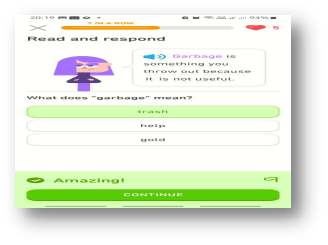
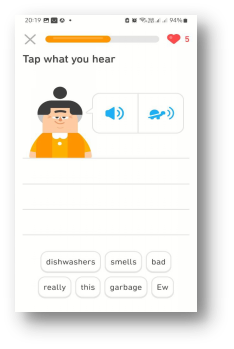
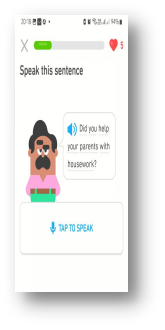
It is known that a high level of anxiety can negatively affect language learners' performance, while those with low anxiety tend to absorb more input. Addressing anxiety and creating a supportive learning environment can significantly enhance language acquisition. Against this backdrop, the researcher has searched for the best mode of creating a supportive, personalized, learner-friendly, relaxed, and comfortable environment to mitigate L2 anxiety. Though several researchers have explored the diverse aspects of language anxiety and digital tools, the possibility of mitigating L2 anxiety with the support of digital tools has been researched sparingly. Duolingo, Grammarly, Rosetta Stone, Quizlet, and Babble, which have unique features that cater to diverse aspects of language learning, were checked in this regard. As per the user demographics of the Duolingo application, there is a growing interest in it among Sri Lankan tertiary-level students. Thus, Duolingo has been selected in particular for this study. Moreover, it has been found that there were approximately 2,703 monthly active users of Duolingo in the country by early 2024, but there is an empirical gap in research on it in the Sri Lankan context. As a result, this research was conducted to examine whether L2 anxiety could be reduced by the fun and easily accessible features of the Duolingo application. (Some authentic images of the Duolingo application are given below.)
AI Duolingo
This was founded by Luis Von Ahn, a professor at Carnegie Mellon University, and his PhD student, Severin Hacker, in 2011. As the most popular language learning application with over 500 million learners, this has one of the world’s largest collections of language learning data. In addition, Duolingo has turned out to be one of the most well-known tools for learning languages that concerns how learners acquire “grammar and vocabulary” in various topics. (Botero et al; Creone & Zhexenbayeva as cited in Mahbub, et al.,2020) It offers personalized learning with immediate grading and real-time feedback. In addition, Duolingo can be a personal language instructor that offers customized teaching and makes learners acquire the language by engaging them in “game-like” activities (Duolingo as cited in Teske,2017) Not only that it can adapt to the specific learning style of the user and provides series of exercises under the four skills, vocabulary and grammar. Furthermore, it has recently introduced new learning paths such as the integration of features like Stories and Tips to expose the learner to innovative learning experiences, while Progress Migration and the redesigned Home Screen add to more effective learning. Additionally, Duolingo has included a Unit guidebook, allowing the learner to review the lesson introductions before commencing due exercises. Duolingo application offers valuable learning resources free of charge but there is a premium subscription called Duolingo Max that includes additional AI-powered features like Explain My Answer, Birdbrain, Role Plays, and Practice Hub which provide learners with excellent unlimited benefits. The study aimed to find the perceptions of the selected teacher trainees in using this digital tool and its special features that support to reduce their anxiety. Finally, the researcher needed to decide whether the Duolingo application can reduce the L2 anxiety of language learners.
The following research questions were addressed to achieve these purposes.
- What are the special features in Duolingo that make the teacher trainees actively engage in the language improvement activities without fear and stress?
- What are the perceptions of the trainees in using Duolingo with respect to communication, language tests, and evaluation?
- Does Duolingo reduce L2 anxiety in trainees?
Methods
A descriptive, qualitative design was used in this research to meet the expectations of the researcher. Descriptive, qualitative research produces data, describing people, topics, and feelings from a personal account. (Doyle et al., 2020). The participants of the research were four teacher trainees following a one-year English Language Teaching Diploma at a leading private institute in Sri Lanka. They were asked to use Duolingo for a period of two months to collect data more accurately. The trainees were regarded as Trainee 1 (T1), Trainee 2 (T2), Trainee 3 (T3), and Trainee 4 (T4). Semi-structured interviews with standardized open-ended questions were administered via Telegram App calls to collect data.
Even though there are many aspects of L2 learning anxiety, the focus of this study was only on Communication Anxiety (CA), Test Anxiety (TA), and Fear of Negative Evaluation (NE). CA arises from the fear of speaking in a foreign language. It is often linked to the fear of making mistakes and being judged by others. Studies have shown that communication anxiety can significantly hinder language performance and participation in class activities. TA is connected to the fear of failing language tests or examinations. TA can lead to poor performance due to the pressure and stress associated with the testing environment. NE is the anxiety often experienced by learners due to the fear of being negatively evaluated by the teachers or peers. This can affect their readiness to participate in class activities and overall confidence in language use.
The interview questions were based on five main scenarios provided by the researcher, allocating forty minutes per trainee. The transcripts were analysed thematically. Scenario (1) was on personal details including family background/ educational level of the parents/ exposure to speaking English at home/ hometown/ school attended/ exposure to English at school and medium of instruction at school/ results of English at State examinations namely; G.C.E (Ordinary Level) and (Advanced Level)/ Scenario (2) was based on Duolingo application/ device used for logging into the Duolingo application/ how often they use the application/the language they have started studying through Duolingo/The language areas (listening, speaking reading, pronunciation, vocabulary, grammar) they want to improve through Duolingo. Scenario (3) was about special features they prefer in Duolingo/benefits. Scenario (4) was focused on their overall perceptions of using the application with respect to communication, and evaluations. Scenario (5) was about their experiences with informal language tests in Duolingo when compared to their previous tests and assessments.
Results
The summary of the data collected from scenarios (1), (2), and (3) can be tabulated as follows.
Table 1 - Personal details of the participants based on scenario (1)
|
Trainee |
Education of parents |
School/s attended |
G.C.E (O/L) English grade |
G.C.E (A/L) English grade |
Medium of instruction at school |
Home exposure to English |
Exposure to English at school |
|
T1 |
Educated |
Suburban |
B |
B |
Sinhala |
Nil |
English period only |
|
T2 |
Not educated |
Suburban
|
B |
C |
Sinhala |
Nil |
English period only |
|
T3 |
Educated |
International |
A |
A |
English |
50% |
90% |
|
T4 |
Well educated |
Foreign/ international |
A |
A |
English |
80% |
90% |
Table 2 -Use of Duolingo application based on scenario (2)
|
Trainee |
Device used |
How long |
How often |
Language focus |
Expected language areas to be developed |
|
T1 |
Smartphone |
2 months |
Daily |
English |
Listening Speaking Reading Vocabulary Grammar Pronunciation |
|
T2 |
Smartphone |
2 months |
Daily |
English |
Do |
|
T3 |
Smartphone/laptop |
2 months |
Daily |
English/Japanese |
Speaking Reading Pronunciation |
|
T4 |
Smartphone |
2 months |
Daily |
Korean/French |
Do |
Table 3 -Special features identified in Duolingo based on scenario (3)
|
Trainee |
Special features identified |
Benefits/Reasons for selecting Duolingo |
|
T1 |
community forums/Profile (add friends, find friends, invite friends/interactive exercises/daily practice with set goals and repeated friendly reminders/encouraging notifications/instant feedback /friendly/rewards/fun application/gamified elements/ repetitive short lessons/quick correction method/Leaderboards (do lessons, earn XP, complete with players in a weekly leaderboard) Shop (earning, refill hearts, unlimited hearts) Super Learners |
Learning is fun as the Duolingo is engaging and game-like/ make learning more enjoyable /effective/quick corrections help reinforce basic concepts/repetitive short lessons strengthen grammar and vocabulary/allow interaction/Super Learners (unlimited hearts, speaking and listening practice on demand, free entry to legendary and time challenges. |
|
T2 |
Interactive gamification (use of points, level, heart reactions/rewards)/repetition of exercises/bite-sized lessons/can make many mistakes/numerous sections or units on different topics/quests (daily quests, earn 10 XP, monthly badges for completing 30 quests)/check followers, statistics, achievements
|
Motivates with feedback /engages in language /if repeatedly answers a question incorrectly Duolingo presents it again with a clear explanation of the grammar rule involved/interactive /fun/engaging/comfortable/enjoyable /less intimidating/ bite-sized lessons fit well into daily routine/global pronunciation/language improvement/ comprehension, engaging and comprehensive learning process. |
|
T3 |
Same data as T2 above/sending emails of notification by the App. Learn multiple languages simultaneously. |
engages in language learning /comfortable/interactive/ no boredom /live/immediate comments and feedback can be encouraging/inspiring |
|
T4 |
Duolingo Super with a 3-day free trial when performs well / units with10 lessons that cover skills / after completing each unit, there's a brief review session consolidating all the lessons/interactive quizzes and immediate scores as a percentage/instant comments and feedback/personalized corrections/
|
opportunity to review mistakes/great as there are no advertisements/encouragement to stay consistent/improving language skills, vocabulary, grammar, and pronunciation /enriching learning experience/easy progress tracking / can compare achievements with other learners in the league based on the experiencing points (XP) collected/effective method/provides immediate insights into correctness |
Table (4)- Coding qualitative data based on scenarios 4 and 5
|
Interview extracts |
Codes |
|
(4) Overall perceptions of the Duolingo application “I find the instant feedback and comments given by Duolingo extremely helpful. They allow me to quickly understand and correct my mistakes, reinforcing my learning. This immediate response helps me stay engaged and motivated, as I can see my progress in real-time and know exactly what areas I need to focus on improving”. “I use various gamification options on Duolingo, such as earning points (XP) for completing lessons, maintaining streaks for daily practice, and competing in leaderboards. These features keep me motivated and make the learning process more enjoyable. The advantage of these gamification options is that they encourage consistent practice, which is crucial for language learning. They also add an element of fun and challenge, making it easier to stay committed and track my progress”. “Using Duolingo to learn English has been a positive and interesting experience for me. The app's interactive lessons make learning engaging and enjoyable. I appreciate the variety of exercises that cover different aspects of the language, such as listening, speaking, reading, pronunciation, vocabulary, and grammar. The gamified elements, like earning points and maintaining streaks, keep me motivated to practice regularly. Overall, Duolingo has been an effective tool in improving my English skills, specially communication skills”. “After finding the app enjoyable and effective for language learning, I also started learning French” “Duolingo has been an enriching language-learning experience for me”. “There's a limit of 5 mistakes allowed per day, but I can earn more chances through practice rounds. Tracking my progress is easy, and I can compare my achievements with other learners in my league based on the XP I collect”. “Challenges provide additional motivation, offering rewards like gems for completing monthly goals” “Duolingo remains a fun and effective method for language learning, combining structured lessons with interactive quizzes and social features”. “I find Duolingo's instant feedback and comments to be incredibly valuable in my language-learning journey. They provide me with immediate insights into the correctness of my answers right after completing the exercises. If I make a mistake, Duolingo not only notifies me but also explains where I went wrong, often citing grammar rules or specific language nuances. This personalized correction helps me understand the language better and motivates me to improve continuously”. “Duolingo reinforces my learning by repeating challenging exercises and providing detailed explanations when I struggle with particular concepts. For instance, if I repeatedly answer a question incorrectly, Duolingo presents it again with a clear explanation of the grammar rule involved. After addressing this revised question, I encounter the original one once more, reinforcing my understanding” “This immediate feedback not only helps me gauge my proficiency but also encourages me to set higher goals and earn more XP based on my performance”. “Duolingo makes learning languages fun with its gamification features” “Keeping a daily streak is a big motivator for me. If I learn every day, I earn rewards and it feels great to see my streak grow. Levels and leagues add another layer of excitement. It's cool to compare my progress and see how I stack up against other learners”. “My experience with Duolingo has been largely positive. The app's interactive and gamified approach makes learning enjoyable and less intimidating”. “Very helpful. Immediate corrections enable me to learn from my mistakes on the spot, reinforcing correct usage and helping me remember the right answers. This feature significantly reduces frustration and boosts my confidence as I can see my progress in real time”. “Duolingo makes learning languages fun with its gamification features”
“Normally I perform reasonably well at language tests. I find that Duolingo testing is a bit different from the language tests I faced earlier in school. In school, the tests were more formal and often focused on grammar and writing skills, which sometimes made it challenging. Duolingo, uses a more interactive and engaging approach, with immediate feedback that helps me understand and correct my mistakes in real-time. So, no fear in facing comments. This difference in testing methods in Duolingo makes me feel less intimidated, and I never forget the stuff in front of others in speaking tests. more beneficial for continuous learning and improvement”. “Duolingo's assessments, are more relaxing and confidence-inspiring. Previously, I was generally not relaxed when facing traditional language tests. I was very afraid to use English in case I make mistakes. Or pronounce wrong. Duolingo makes me feel more engaging and less stressful due to its interactive approach. I engage in various exercises including listening, speaking, reading, and writing, all of which are designed to enhance language proficiency through enjoyable challenges and quizzes. In listening activities same words can be heard multiple times. This natural progression boosts confidence. “Activities in Duolingo help reinforce my understanding and improve my fluency, making it easier to perform well in language tests.” |
-Realtime feedback -Engagement and motivation/ positive reinforcement
-Earning extra points/maintaining streaks/leaderboards -enjoyable/motivated/encouraged/ability to track progress -Element of fun make less stressed and challenging
-Encourage practice/interactive lessons/variety of exercises/regular practice improve language skills /progress tracking
-Positive/interesting/enjoyable experience -Variety of activities catering 4 skills, grammar and vocabulary -Gamified elements - Tool for communication skills
-Learning other languages
-Enriching language learning experience -Progress tracking
-Compare achievement with others in the league -Motivational challenges -Instant feedback/insights into correctness/personalized corrections
-Reinforces learning
-Notification of mistakes
-Personalized corrections
-Immediate feedback
-Fun activities/fun learning
-Motivating -Compare progress against others
-Positive experience/less intimidating/enjoyable
-Spot mistakes/reinforce correct usage Reduces frustration/helpful/boost confidence when seeing real time progress.
-Formal testing at school based on grammar and writing make more challenging and stressed -Interactive, engaging tests in Duolingo with immediate feedback makes motivated and encouraging -Less stressed and frightening/ confidence in facing speaking tests/ nothing forgotten in tests.
-Active engagement in language test items -Listening skills developed by hearing same pronunciation several times. -Tests with natural progression builds confidence. -Easier to perform well in language tests |
Table (5)- Turning codes into themes
|
Codes |
Themes |
|
4)Overall perceptions of the Duolingo application Real-time feedback/Stay engaged/Motivated/Earning extra points/maintaining streaks/leaderboards enjoyable/motivated/encouraged/track progress/Element of fun makes less stressful and challenging/Interactive lessons/variety of exercises/regular practice improve language skills /Learning French
Enriching language learning experience/Compare achievement with others in the league/Challenges/ gems for monthly goals/Interactive quizzes/social features/Instant feedback/insights into correctness/personalized corrections Reinforces learning/Immediate feedback/Fun activities/Motivating/Compare progress against others//Positive experience/less intimidating/enjoyable/Spot mistakes/reinforce correct usage/Reduces frustration/Helpful/boost confidence when seeing real time progress. 5)Experience of language tests and assessments Formal testing at school based on grammar and writing make more challenging and stressed. Interactive, engaging tests in Duolingo with immediate feedback makes motivated and encouraging. Less stressed and frightening/ confidence in facing speaking tests/ nothing forgotten in tests/active engagement and participation in language test items. Listening skills developed by hearing same pronunciation several times/tests with natural progression builds confidence/easier to perform well in language tests.
|
(1) Cognitive engagement, emotional engagement and behavioural engagement (2) Comfortable zone (3) Self- directed, self -regulated learner
(4) Language improvement, pronunciation, vocabulary, grammar, additional languages like French (5) Enriching language learning promotes communication/ language learning phobia (6) Boost confidence/positive environment/less intimidating/encouraging/helpful
(7) Formal tests in school Vs Interactive, engaging less stressful tests (8) Natural, confidence-building language tests (9) Positive /Real time feedback /diminish phobia for evaluation |
The following conclusions can be arrived at based on the main themes.
Conclusion
- Learner-friendly, manifold gamification options, bite-sized lessons, and interesting features in Duolingo create a positive, relaxed, supportive, enjoyable, comfortable learning environment. Learners had a positive perception of using the application with respect to communication, language tests and evaluation.
- Diverse aspects of tasks promote active learning and learner engagement, self-directed and self-regulated learning.
- Duolingo dispels apprehension and boredom while boosting confidence through encouraging comments and feedback in practising activities and tests. Thereby, the fear of negative evaluation cannot be identified.
- Duolingo never promotes shyness or phobias in communicating a second language. Thereby, significantly promotes language performance in speaking. As a result, communication anxiety cannot be seen among learners.
- As Duolingo creates a stress and pressure-free, encouraging environment for the learners, fear of failure and forgetting at second language tests (test anxiety) is not visible.
- The emotional discomfort of the learners could be minimized, and better language achievement at various levels would be experienced.
- As a result, there is a potential for this digital tool to reduce language learning anxiety, enhance confidence, and motivate learners.
- Thus, Duolingo plays a vital, effective, and dynamic role in reducing second language anxiety among learners.
References
Ajisoko, P. (2020). The use of Duolingo apps to improve English vocabulary learning.
International Journal of Emerging Technologies in Learning (IJET), 15(7), 149–155.
Alfuhaid, S. R. (2021). The utilisation of Duolingo to enhance the speaking proficiency of EFL secondary school students in Saudi Arabia. English Language Teaching, 14(11), 9–15
David et al, (2012) An Interpersonal Approach to Classroom Management: Strategies for Improving Student Engagement, p 22
ELTR Journal, e-ISSN 2579-8235, Vol. 4, No. 2, July 2020, pp. 29-37
Handini. B.S., Nurhasanah, & Panly. F.I., (2022). The Effect of Artificial Intelligent Technology Used (Duolingo Application) to Enhance English Learning. English Language, Literature, and Teaching, 7(2),86-94 doi:10.32528/ellite.v7i2.8354
Krashen, S. D. (1982). Principles and Practice in Second Language Acquisition. Pergamon Press.
Lou, N. M. & Noels, K. A. (2020). Mindsets matter for linguistic minority students: Growth mindsets foster greater perceived proficiency, especially for newcomers. The Modern Language Journal, 104(4), 739–756.
Malintha, C., & Gunawardhana, L. K. P. D. (2024). Gamification for Learning English as a Second Language in Sri Lanka. Education Quarterly Reviews, 7(2), 139-146.
Onwuegbuzie, A. J., Bailey, P. & Daley, C. E. (1999). Factors associated with foreign language anxiety, Applied Psycholinguistics, 20(2), 217–239.
Papi, M., & Khajavy, H. (2023). Second language anxiety: Construct, effects, and sources. Annual Review of Applied Linguistics, 43, 127–139. doi:10.1017/S0267190523000028
Politeknik, D., & Binaprestasi, M. (2022). The Effectiveness of Duolingo Application in Helping Students. Jurnal Ekonomi, Bisnis dan Teknologi. 2(2), 85–97.
Please check the Pilgrims in Segovia Teacher Training courses 2026 at Pilgrims website.
Reducing Second Language Learning Anxiety Among ELT Diploma Trainees in Sri Lanka: The Role of AI Duolingo
Priyanka Kumarasinghe, Sri LankaTaiwanese Freshmen’s Preferences and the Effects on Vocabulary Acquisition of Online Annotation for Reading an Extended Text
Chin-Wen Chien, TaiwanAssessing Listening Placement Tests in English through Digital Technologies
Alexis Vasquez, ColombiaFormative Assessment Using Time Sequenced Analysis: Assessing Learning According to the Way Languages are Acquired
Miriam C.A. Semeniuk, Canada