On Snow, Christmas and the British
Mojca Belak is a lecturer at the University of Ljubljana, where she teaches British Studies, practical classes in English phonetics and phonology, and General English. She is a former Pilgrims trainer, a longstanding member of IATEFL and an occasional contributor to ELT Magazine. She likes exploring intercultural matters. Email: mojca.belak@guest.arnes.si
Introduction
British weather is famously unpredictable — or at least that’s what learners are told in English classes. Yet, if Christmas films and seasonal TV specials are to be believed, there is one day of the year when the weather rarely disappoints: the British almost always get snow for Christmas.
Every culture has its obsessions. Slovenians, my compatriots, are convinced that our country is breathtakingly beautiful — woe betide any visitor who disagrees. The British, it seems, have a different obsession: a sprinkling of snow in the closing scenes of their Christmas films. In reality, however, the UK hasn’t seen much Christmas snow for years. According to the Met Office, there were on average 13 days of lying snow per year between 1991 and 2020, most of it confined to the mountains.
Snow in British Christmas films and TV specials
British series, particularly period dramas, are celebrated for their historical accuracy. Historians guard against anachronisms, while experts check language and pronunciation. But when it comes to Christmas weather, realism gives way to fantasy — and their British audience does not seem to object.
Take Downton Abbey’s 2011 Christmas special (S2E10): Matthew proposes to Mary as snow begins to settle. They stand outside; the snow crunches underfoot, suggesting sub-zero temperatures, yet Mary is dressed in a sleeveless frock, untroubled by the cold. Besides, records for the winter of 1919–1920 show snow in September, November, and February — but not in December.
In the last scene of 2024 Christmas special of All Creatures Great and Small (S2E7), Mrs Hall looks out at lightly falling snow. Historical records confirm snow in the winter of 1941–42 — but only from January to March, not at Christmas.
And who could forget Bridget Jones’s Diary (2001)? Bridget rushes after Mark Darcy into a snowy London night, clad only in underwear and a cardigan. They kiss in the falling snow and are in no hurry to get somewhere dry and warm. Eventually Mark puts his coat around her — not because she’s freezing, but because passers-by are gawking at her outfit. Needless to say, it did not snow in London at Christmas in the 1990s.
At the end of Midsomer Murders (S11E6, 2008), Tom Barnaby and his wife sing a carol as snow begins to fall. Their winter clothes are appropriate — but the weather isn’t. Earlier in the episode, Barnaby and Jones fell into mud and water, conditions incompatible with the powdery snow shown later, which only falls in deep frost when the ground is frozen solid.
The British and real snow
Over time, I came to understand that the British don’t really like snow when it arrives on their doorsteps — that is on their roads, pavements, and railway lines. When I once experienced snowfall in London, even an inch brought traffic to a halt, the Underground included. For many, snow is not romantic at all but damp, cold, and inconvenient. Slovenians, by contrast, often revel in it — usually without umbrellas.
A decent snowfall just before Christmas would cause chaos in the UK. In countries accustomed to snowy winters, people adapt: Slovenians switch to winter tyres by law every November; many Swedes cycle through the snow with winter tyres on their bikes; Finns wear studded shoes against ice. The British, by contrast, rarely prepare — the odds of snow are too low. When it does arrive, it catches them off guard.
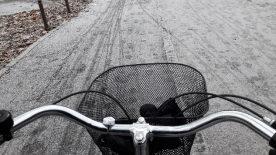
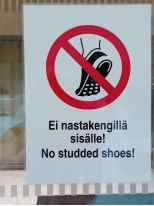
Pic. 1: Cycling in the snow Pic. 2: A note in front of a Helsinki office
I saw this fear of snow firsthand when British friends visited Slovenia. One, driving a van, insisted on fitting snow chains the moment snow began to settle, despite well-cleared roads. Another panicked about reaching the airport after heavy snowfall, only to find the bus service running on schedule. A third, traveling with me to teacher-training workshops, was astonished at how we crisscrossed the snowy country without delay. Impressed, he called his wife back home to suggest they invest in winter tyres.
Snow as a cultural construct
Because real snow is scarce, British filmmakers either don’t know how to portray it accurately or don’t care. Advertisers exploit its fairy-tale charm, filling Christmas advertisements with pretty snowscapes, snowmen and sledges. Why? As one Quora contributor observed, British Christmas ads would be “far less effective … if they depicted a typical grey [drizzly] Christmas Day without a flake of snow to be seen.”
The snow in British Christmas specials, then, is not so much about weather than it is about culture. It may frustrate those of us from snowier countries, but it demonstrates the power of cultural imagination: for the British, Christmas and snow belong together. Therefore, English teachers should gently remind learners that when it comes to snow in British Christmas films and TV specials, it should not be taken at face value.
References
Bonacina L. & O’Hara (2025). UK Snowfall History British Winter Snowfall Events 1875-2025. URL: https://durhamukweather.com/wp-content/uploads/2018/10/bonacina.html
Met Office. (2025). UK snow and facts. URL: https://weather.metoffice.gov.uk/learn-about/weather/types-of-weather/snow/snow-in-the-uk
Quora. (2018). Why do we associate Christmas with snow in the UK when in many areas it is quite unusual. URL: https://www.quora.com/Why-do-we-associate-Christmas-with-snow-in-the-UK-when-in-many-areas-it-is-quite-unusual
Please check the Pilgrims in Segovia Teacher Training courses 2026 at Pilgrims website
On Snow, Christmas and the British
Mojca Belak, SloveniaPalestinian Students’ Teachings on Life, Hope and Sumud
Stephen Reilly, UKThree Voices from Pavilion